Announcements
-
Network and Communication Technologies: Call for Papers
Posted on Aug 19, 2026 Network and Communication Technologies (NCT) is calling for submission of papers for the 2026 issues. Read More
Current: Vol. 10, No. 1 (2026) 

-
- Federated Learning in Smart Home Intrusion Detection: Securing the Learning Process with Blockchain
-
- Aon Alhinah
- Ismail Keshta
- p1
 PDF
PDF
Journal Publishing Workflow
Please see the workflow for the article publication:
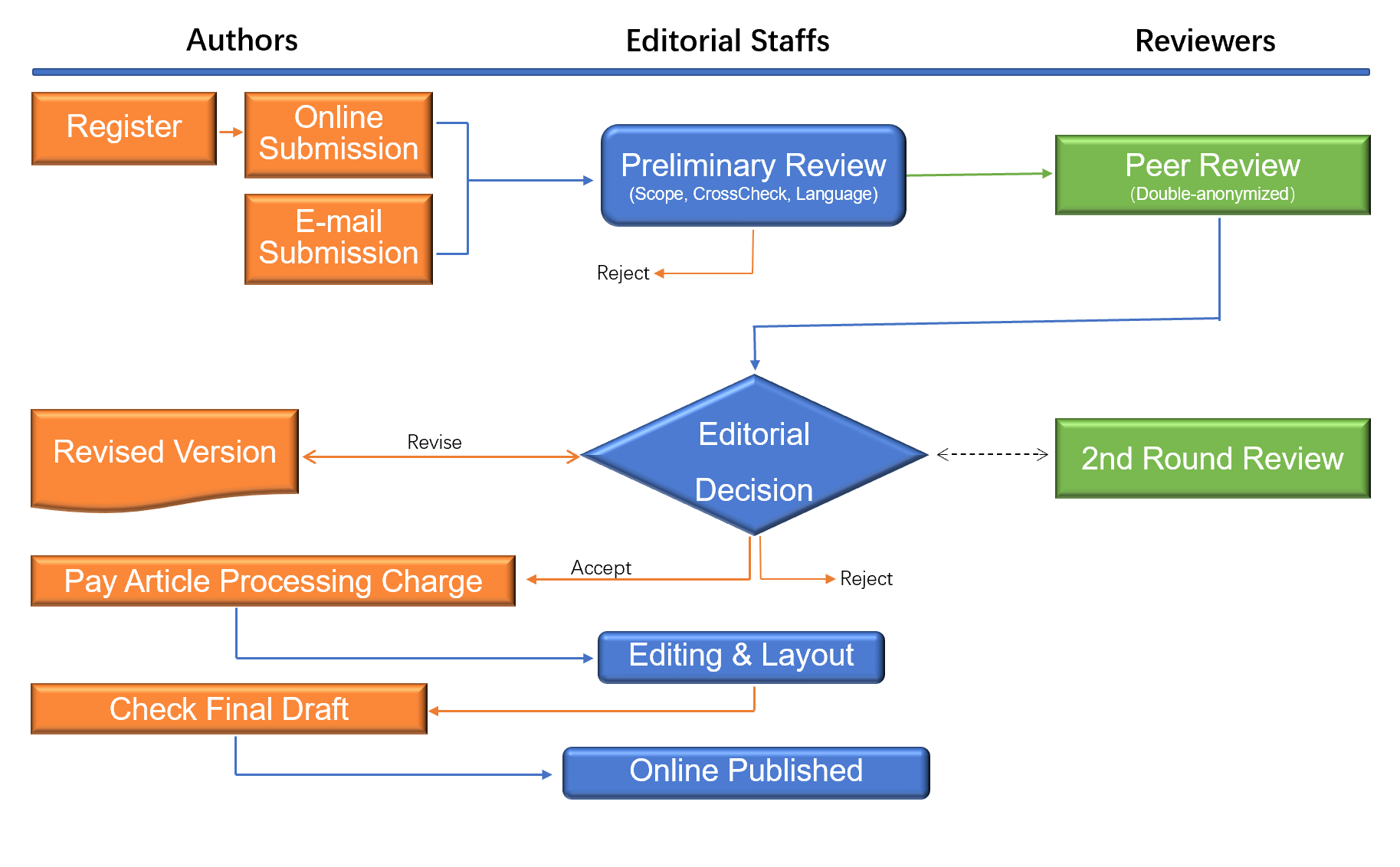
Paper Selection and Publication Process
a) Submission acknowledgement and initial screening. The journal normally acknowledges receipt of a submission within one to three working days. The editorial office conducts an initial assessment of the manuscript’s completeness, relevance to the journal’s aims and scope, originality, ethical compliance, reporting quality, and conformity with essential submission requirements. A manuscript may be returned to the authors or rejected without external review when it clearly does not meet these requirements. If another CCSE journal appears more appropriate, the editorial office may offer the authors an optional manuscript transfer. No manuscript or associated submission information will be transferred without the authors’ consent.
b) External peer review. Manuscripts that pass initial editorial screening are normally evaluated through double-anonymized peer review by at least two independent external reviewers with relevant expertise. Editorial screening is not counted as external peer review. Although the journal takes reasonable steps to protect anonymity, complete anonymity cannot be guaranteed because author identity may be inferred from preprints, citations, datasets, conference presentations, or the subject matter. The review process normally takes approximately four to ten weeks but may vary according to reviewer availability, manuscript complexity, revision requirements, and ethical or technical checks.
c) Editorial decision. Reviewer recommendations are advisory. The editor makes the editorial decision after considering the reviewers’ reports, the manuscript’s scholarly quality, relevance, originality, methodological or analytical validity, ethical compliance, reporting quality, and any other relevant information. Possible decisions include acceptance, minor revision, major revision, rejection with an invitation to submit a substantially revised manuscript as a new submission, or rejection.
d) Revision and acceptance. When revision is requested, authors must submit a revised manuscript together with a point-by-point response explaining how each comment has been addressed or why a suggested change was not made. A request for revision does not guarantee acceptance. Article processing charges are requested only after final acceptance, in accordance with the fee information published on the journal website.
e) Publication and access. Following acceptance, production, approval of the page proofs by the corresponding author, and completion of any applicable administrative requirements, the article is published online as the version of record. Published articles are made freely and immediately available under the open-access license stated in the article.
--------------------------------------------------------------------------------------------------------------------------------





 This work is licensed under a Creative Commons Attribution 4.0 License.
- ISSN(Print): 1927-064X
- ISSN(Online): 1927-0658
- Started: 2012
- Frequency: semiannual
Journal Metrics
Google Scholar-Based Metrics (2026):
- Citations (June 2026): 938
- h-index (June 2026): 14
- i10-index (June 2026): 15
Index
Contact
- Bruce LeeEditorial Assistant
- nct@ccsenet.org